
Press Release
Strengthening Farmer Capability to Improve Sustainable Cocoa Practices Through the Training of Trainers

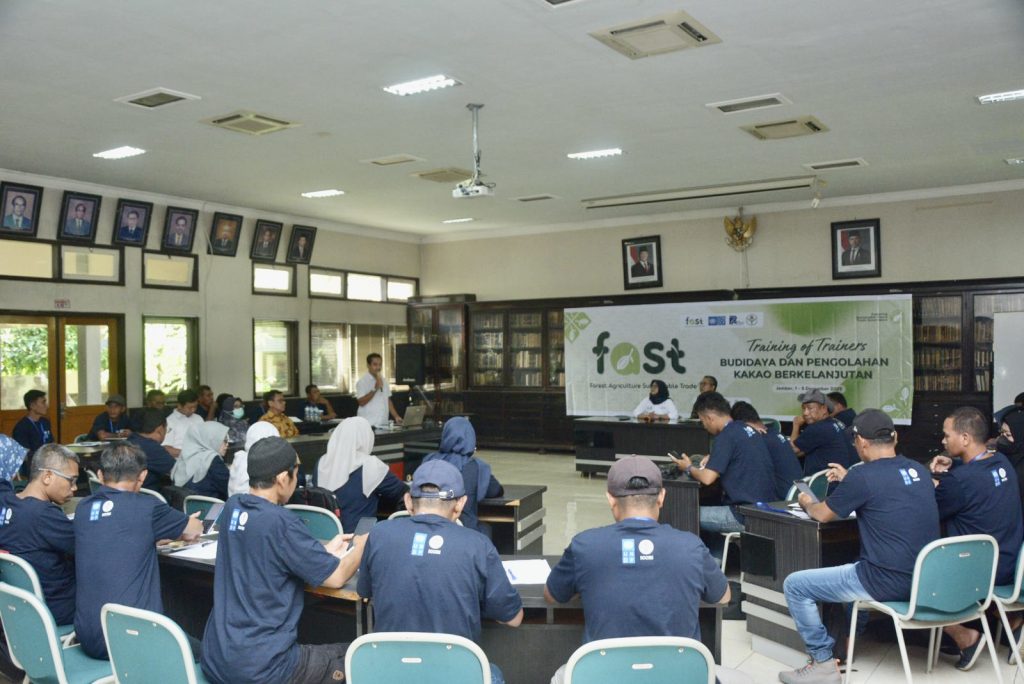
Jember, 1 December 2025 – The United Nations Development Programme (UNDP), in collaboration with the Indonesian Coffee and Cocoa Research Institute (ICCRI), officially launched the Training of Trainers (ToT) on Sustainable Practices for Cocoa Cultivation and Processing under the Forest Agriculture Sustainable Trade (FAST) Cocoa Project. Held from 1–5 December 2025 at the ICCRI Campus in Kaliwining, Jember, the programme brings together trainers, community facilitators, and field practitioners from key cocoa-producing regions, including Lampung, Central Sulawesi, East Kalimantan, and East Java.
As one of the flagship components of the FAST Cocoa Project, the ToT aims to strengthen Indonesia’s cocoa value chain through enhanced farmer capacity, community empowerment, and climate-resilient agricultural systems. Participants receive structured training designed to deepen their understanding of Good Agricultural Practices (GAP) and Good Handling Practices (GHP), improve farm and post-harvest management, and explore opportunities to develop community-based value-added cocoa products. In addition to technical modules, the programme highlights women’s involvement, financial literacy, and inclusive decision-making to ensuring that both men and women in cocoa farming communities benefit from improved knowledge, greater participation, and increased economic opportunities. This comprehensive approach positions trainers as agents of change who can support farming households and communities more effectively.
The opening ceremony featured remarks from Iwan Kurniawan, Programme Manager NRM Cluster, Nature Climate Energy, UNDP Indonesia and ICCRI representative Indah Anita Sari, who underscored the urgency of strengthening farmer capacity amid declining national cocoa productivity and increasing climate-related pressures.
“Indonesia’s cocoa sector holds tremendous potential, but realizing this potential requires strong farmer capacity, inclusive community participation, and climate-resilient farming systems. Through the FAST Cocoa Project, we are committed to equipping farmers and trainers with the skills, knowledge, and confidence needed to uplift their productivity and strengthen their livelihoods. This Training of Trainers programme is not only about improving technical practices it is about empowering communities, expanding opportunities for women, and building a more sustainable and competitive cocoa sector for the future.” – Iwan Kurniawan, Programme Manager NRM Cluster, Nature Climate Energy Unit, UNDP Indonesia.
Delivered under ICCRI Training Centre’s ISO 9001:2015 quality standards, the programme combines classroom-based learning with hands-on field practice to ensure both technical precision and practical application. Over the five days, participants engage in modules covering land preparation, cultivation techniques, pest and disease management, post-harvest processing, cocoa bean quality enhancement, and value-added product development. Sessions on community facilitation and financial literacy further ensure that trainers gain holistic competencies. As part of the certification process, participants undergo pre-test and post-test assessments administered by ICCRI to measure learning progress and ensure readiness for field implementation.
“ICCRI is proud to collaborate with UNDP in advancing sustainable cocoa practices across Indonesia. By integrating science-based methods, community empowerment, and financial literacy, we aim to ensure that farmers have access to practical solutions that can be applied directly in the field. This initiative reinforces ICCRI’s long-standing dedication to supporting farmers and strengthening Indonesia’s cocoa value chain starting from the ground up.” – Indah Anita Sari, Head of Research, Indonesian Coffee and Cocoa Research Institute (ICCRI)
The Training of Trainers programme reinforces Indonesia’s progress toward the Sustainable Development Goals through a multidimensional approach that integrates economic, social, and environmental priorities. By strengthening cultivation practices, improving post-harvest handling, and opening avenues for value-added products, the initiative contributes to poverty reduction by expanding income opportunities and enhancing farmer resilience.
The programme’s emphasis on financial literacy and women’s participation ensures more equitable involvement in decision-making and household economic management, reflecting a strong commitment to advancing gender equality and inclusive development within cocoa-growing communities. At the same time, the integration of climate-resilient agriculture and forest-friendly land management supports sustainable landscapes and protects local ecosystems. These efforts help communities adapt to climate variability, preserve biodiversity, and promote responsible and sustainable production across the cocoa value chain. Through these combined efforts, the ToT programme demonstrates how practical training, science-based innovations, and community empowerment can drive sustainable, resilient, and inclusive cocoa production is fully aligned with Indonesia’s SDG commitments and the broader goals of the FAST Cocoa Project.
This initiative reflects the continued commitment of UNDP, ICCRI, and the Indoonesia Government to strengthening farmer capability and advancing a more resilient, inclusive, and competitive cocoa sector in Indonesia. By empowering trainers with the necessary technical knowledge and socio-economic tools, the programme ensures that sustainable cocoa practices can be widely adopted and scaled across regions benefiting communities, ecosystems, and the national economy.


